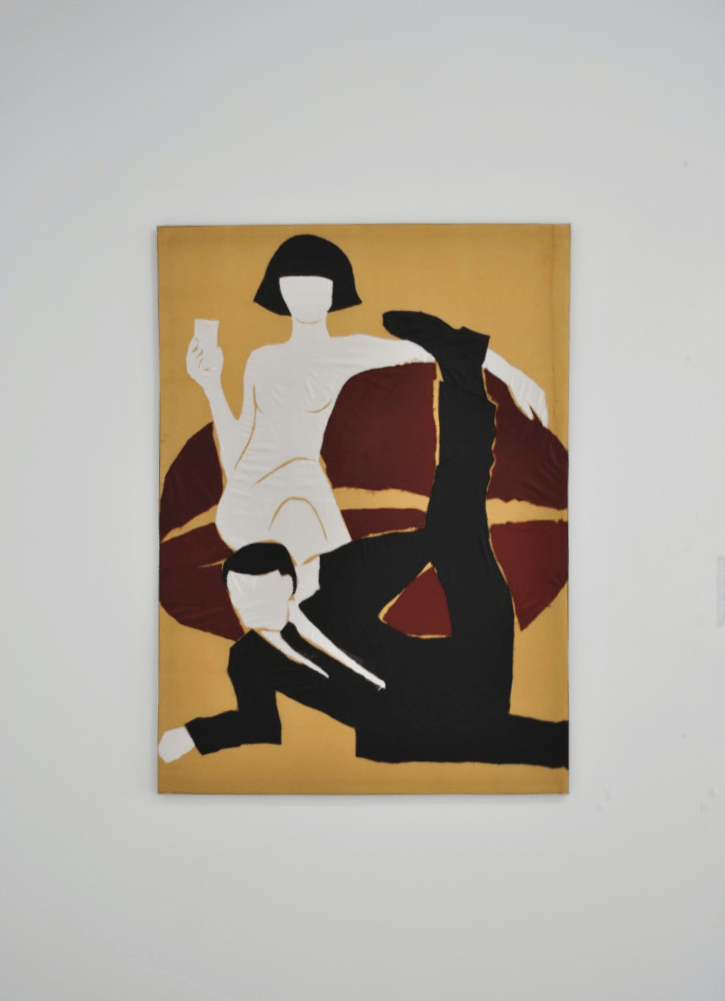
This year, the 8th of March was marked by a dignifying march, on Khreshchatyk square to celebrate women as strong and independent individuals. Meanwhile, the launch of this exhibition bolstered March as the month of female strength, independence and solidarity, by confronting both male and female roles and expectations in contemporary society.
Self-expression was epitomised through an ancient female medium – embroidery. Group of female artists all had their own interpretations of what it means to be marginalised as women and their own ways of demonstrating them, some being more radical than others. What unites these women, is that (almost) all of them have dedicated themselves to create a stitched piece of artwork. Some experimented with cloth and canvas, merging the two together. Artists use knitting as a means of highlighting the concerns of gender equality and illustrating various topics of concern. In fact, textlie here is used primarily as a canvas, a blank slate, which can be transformed into any given shape.
The idea to convey feminist message through a traditionally ‘female’ medium is not new — Miriam Schapiro demonstrated it through her work of feminist messages on textile canvases. Moreover, it the recent decade it has been in high demand within fashion and now design industry – we only need to remind ourselves of product designer Patricia Urquiola’s vivid carpets. Textiles are rapidly becoming associated with professional, rather than domestic scenes.
«Textus. Embroidery, textile and feminism» explores the topic of feminism and questions the gender roles imposed by the society through creation of textile pieces. Words ‘textile’ and ‘text’ have the same origin, from Latin – ‘textus,’ which means to ‘intertwine.’ Throughout history, it was male narrative that dominated and shaped societal discourse. They intertwined text, whereas women were weaving threads. This idea is very pertinent, particularly in Ukraine, since embroidery was traditionally considered (and in some ways, still is), as female appanage. Female artists endeavour to intertwine text and meaning, through the means of textile, which renders it so appropriate. Moreover, artists succeeded in juxtaposing two opposing messages through the same medium – embroidery as a medium of ancient stereotype of women as ‘keepers of the household,’ and embroidery as a means of female emancipation through production of artworks.
All participants have chosen their own subjects of study – textile collages, embellishing existing objects, e.g. jackets, aprons. For instance, in the «Man’s World Series,» Alina Koputsya uses a suit as an emblem of corporate world and success, and brings it to attention by juxtaposing these men in suits within an incongruous context – a forest, thus questioning male role as a breadwinner altogether — whether he should be pressured to earn high wages and be competitive. Overall, this group of female artists’ choice of medium is crucial in understanding the importance of the message they are trying to convey – the refusal to accept the status quo in society. By using textile as a means of protest, women state that even though embroidery used to be a hallmark of discrimination towards their gender, it doesn’t necessarily mean that it cannot be used as a means of protest.
This topic of feminism is relatively new in Ukraine – people have a quite narrow understanding of what it implies. Some Ukrainians only associate it with a quasi-feminist organisation – the «Femen» group. They are largely known for parading topless and wearing flower wreaths in their hair. However, recently, the situation started to change – people became more familiar with ideas and concepts of feminism and began frequenting lectures on said topic. On 8th of March, the International Women’s Day, Ukrainian girls usually would receive tonnes of flowers and chocolates from men, celebrating their traditional role as the ‘keeper of the household.’ However, this year, instead of a day of indulging in chocolates and compliments on being ‘tender creatures’, women participated in a march in the centre of Kyiv – on the Khreshchatyk.
 Alma libera