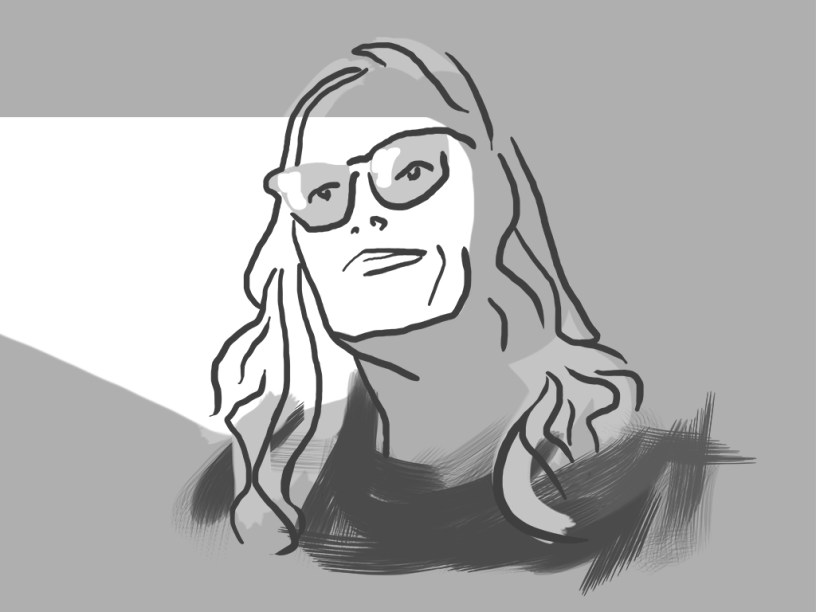
And why she is the underrated anti-heroine of comedy
Disclaimer: This is a long read. Initially I just wanted to defend Britta against online haters, but it grew into something more – a character study. Much like Britta, I am not a licensed therapist, nor do I have a degree in psychology or film studies. Neither am I a literature major, nor a native English speaker. My drive to write this piece was based on my love of writing, Community and Britta Perry. If I haven’t deterred you from reading my essay yet, please enjoy my take on the one-of-a-kind, pro-anti, I-guess-there’s-no-hug-button, Britta Perry.
“Oh, Britta’s in this?”
DAMN STRAIGHT SHE IS.
By the middle of Community’s season one, Britta’s character shifts from being Jeff’s crush to an outlet (along with Pierce) for group’s mockery: from making fun of her pronunciation of bagels (‘baggles’) to using her name as a verb to mean to ‘ruin something’. I will admit, some lines made at her expense are hilarious – “ugh, you’re the AT&T of people”, yet I failed to grasp why she was deemed as the worst by the group. Additionally, many fans of the show added fuel to the fire by posting “Oh, Britta’s in this?” practically under every YouTube video that she’s in. Even though this quote is hilarious within the context, I felt a snarky undertone to this trend. In this vein, Gillian Jacobs admitted herself that she enjoyed playing a character who went from “a girl on the pedestal…to like, ‘you’re the worst, please leave’ “. Yet, it’s another thing to solely view her from this angle alone, dismissing all of her great qualities. I always found Britta refreshing from other heroines in the comedy canon, so I decided to investigate why people were so quick to dislike her. Partially the problem lies with us. We, as an audience, tend to overlook characters that are laughed at, since we are not taught to sympathise or side with them. But if we isolate Britta from the group’s reaction, we can discover her for a kind and compassionate person she really is. In Abed’s words “we will see her value.” But before we do that, let’s look at Britta from the outset.
Joyless Division
So what’s the deal, Jessica Biel? Why do so many people hate Britta?

As Dan Harmon admitted himself, Britta wasn’t envisioned as an annoying character from the get-go. But after talking to one of the female writers on the show, he realised that she is not someone women would choose to be friends with. So, instead of making her more likable, Harmon decided to enhance her flaws and pick on her humourless aspect. As a result, Britta became someone who is self-righteous, conceited and defiant. She was still meant to be the ‘sensible and practical one’ in the group, yet they slashed that idea as well by making her the piñata of it. To paraphrase Harmon, “instead of saddling her up with status, they beat her up”. This is seen as early as Spanish 101, when Shirley comments on Britta’s criticism of her and Annie’s protest: “someone has a case of ‘I use fringe politics to make myself feel special, but doesn’t actually want to do anything’ -itis.” Therefore, her being ‘the worst’ was a conscious act by the creator and writing staff. However, just because she is called ‘the worst’, doesn’t mean she was hated; on the contrary, very much loved.
However, with this severity comes depth, which a lot of sitcom characters traditionally lack. It gave her an ability to react differently and introduce another palette of emotions to the group, which actually enriches the group’s dynamic. She’s the anti-Winger. Additionally, Gillian Jacobs’ work in drama, as opposed to comedy genre only amplified this idea of Britta being intrinsically not funny.
Britta Against the Machine

Need a fake ID? Britta will hook you up. Want to start a riot? Britta will be there with posters and spray paint. Need to break into someone’s apartment and steal their faucet? Done and done. We are introduced to Britta as a pot-smoking slacker, who instead of focusing on her education prefers to distract herself anyway she can, usually by getting involved in people’s lives. Before Greendale, Britta was part of the An-her-chists collective that spray-painted billboards in Banksy fashion. After the group decided to split, Britta joins Greendale Community College in hopes of getting an easy degree. Even though, she seemed to settle into her new life, she continues to protest in Greendale as well, although to a lesser degree (journalist censorship and oil spill protests). By season three, Britta has embraced her new academic path, but is still nostalgic for her rebellious days. For instance, in Geography of Conflict, she finds out that her friend is imprisoned in Syria for protesting against an oppressive regime. She stages a sit-in allegedly against the United Nations, however it is more of a venting act, because she’s envious that her friend is doing something meaningful. We see that she misses having a purpose. Defiance is a big part of Britta’s personality, therefore she gets frustrated when she doesn’t have an outlet for it.
While people might complain that Britta is plaguing everyone with her persistent rants on everything from oligarchies to weddings, I think she is voicing the unpopular opinion that others are unwilling to share out of blatant fear of being cast out. Britta isn’t afraid of adversity, on the contrary – she welcomes it with open arms. And sometimes it yields unforgettable results. Her rebellious spirit is best encapsulated in App Development and Condiments, where Britta’s ability to go against the crowd is shown in its full glory. She openly defies the established hierarchy and successfully manages to rally everyone against the rule of the fives, famously exclaiming, “LONG LIVE THE REVIEWLUTION!!!” As a bonus, and in a beautifully bizarre Community fashion, we see Britta as a reincarnation of Che Guevara, the Mother of Ones that reduces everyone to ‘oneness.’ Therefore, shouldn’t we be applauding her ability to think independently and speak up, instead of judging? Isn’t she a great example of a woman, who yes, has more fights than a YouTube comment section, but isn’t afraid to use her voice regardless of what others think of her? So, instead of rolling our eyes at her, maybe we should be saying, “you go, girl“? And not ironically.

Britta for the Win
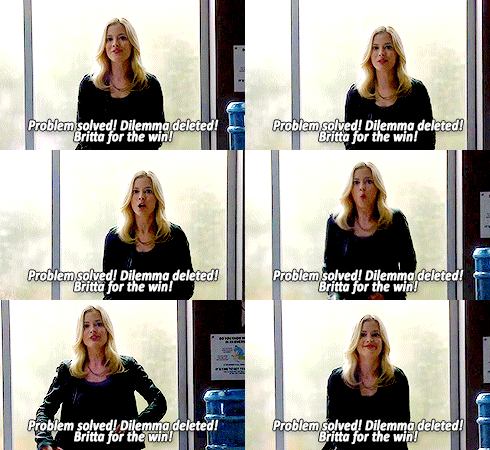
True, Britta offers a lot of comedy relief to the group by constantly failing. Whether it’s an underwhelming-prank-turned-crime-scene in Science of Illusion, or accidentally killing Pierce in a video game while giving him a pep talk in Digital Estate Planning, Britta just keeps going, reminding us that it’s okay to mess up. But these screw-ups create a special kind of superpower – she doesn’t judge those who fail either. This makes other people comfortable to be around her. For example, in Contemporary Impressionists after Jeff’s maniacal episode at the bar mitzvah party, Britta picks him up on the curb and takes him home.
There is an expression in Russian language, “Хотелось как лучше, а получилось как всегда”. Rough translation – “despite the best intentions, things turned out for the worst”. Sometimes Britta fails, but you gotta give it to her – she is relentless when it comes to her friends. She never gives up on them, because she knows from experience what failure is like.
“I loved about that character that she wanted to do well, but always got in her own way, but was also undaunted by other people’s scorn. She just kept going no matter how much people made fun of her.”
Gillian Jacobs
Britta is labelled as a buzzkill throughout the series, but is she though? In Remedial Chaos Theory, it is Jeff that cuts Britta off as soon as she starts belting out Roxanne. Everyone seems to obediently comply with Jeff’s sentiment, with Annie even nodding to reaffirm that. Yet, as soon as Jeff goes to fetch pizza, Britta starts singing and dancing and everybody immediately follows suit. Takeaway? Sometimes, it’s Jeff who’s the killjoy, while Britta turns a casual dinner with friends into one of the most epic moments in the history of Community.

Venus in Arms

“That woman is a hurricane.”
“Yeah”.
“Hurricanes are bad, Troy.”
“I know!”
Jeff and Troy
To quote a film analysis channel The Take, “viewers [are] culturally-primed to be judgmental of bad behaviour in women“. Any female character that strayed from that description required to be tamed, for example Kat from 10 things I hate about you. True, there has been a plethora of unlikable women on screen since Community, including Claire Underwood from House of Cards, Fleabag from the eponymous Fleabag, HBO’s Girls and so on. But, they are primarily dramas or dramedies that have aired after 2010, whereas Community premiered back in 2009. Since art reflects our cultural norms, it’s not surprising that a character like Britta receives mostly criticism – she doesn’t comply with expectations, especially by male characters. She doesn’t sugar-coat things either, which is why she gets dissed a lot by the group. That’s why we might feel second-hand embarrassment for her when she says ‘baggle’ instead of bagel or questions whether worms have faces, because members of the group consider it weird. But that’s the point – why should we? Britta is just being who she is – just because it doesn’t coincide with others’ expectations doesn’t mean she should cave and change her attitude. That is where her strong suit lies – being okay not always being liked by others. She is a good example for someone like Annie, who is young, naïve and often represses her unattractive qualities in favour of being more palatable. This is best illustrated in their fundraiser for the oil spill they both organised. Britta speaks in a frank manner, encouraging people to donate, while Annie employs her looks and a flirtatious technique to manipulate guys into giving them more money. It’s okay that she does it, but Britta shows there are other ways to make people listen.
Even though Britta is a hottie, she’s never ostensibly sexualised, which is a rare sight in American sitcoms. Yes, she is portrayed as attractive (“she’s no barrel of monkeys”), but her sexuality is painted as direct and awkward, and her flirting technique is mocked. Usually a character like Britta is fawned over by male characters, and her unlikable traits go unnoticed. Take Emma Swan from Once Upon A Time, for instance. At first glance, they are similar characters: both blondes, who sport leather jackets and have guarded personalities. However, unlike Britta, Emma seems to be worshipped by most of the men in Storybrooke – practically every good-looking guy she meets sooner or later develops a crush on her (Graham, August, Captain Hook). This gives us an impression that guys won’t be dismissive of her despite the defiant attitude, because of her long eyelashes and golden locks. Writers imply that physical hotness can absolve responsibility from any attitude or dubious acts, therefore we as an audience tend to forgive them. That’s not the case with Britta, as she quickly becomes the go-to for all of the group’s jokes, which are usually made at her expense. In Community, male characters are undaunted by Britta’s good looks. Not only is she held accountable for her acts, but she is constantly ridiculed for anything she does. In Custody Law and Eastern European Diplomacy, Britta steals a DVD from Abed, in order to ‘break up’ him and Troy with Lukka, because of his past as a war criminal. However, when they catch her red-handed, Troy and Abed give her a hard time and even call her a monster. That is a more true-to-life story – just because you’re good-looking, doesn’t mean you will get away with things. In the commentary tracks from season one, Donald Glover aptly observes, “Bagging on somebody who is really pretty is funny to me.” Probably, because it’s such a rare thing not only in sitcoms, but in cinema in general. When we see someone pretty bearing the consequences for their actions, it restores our faith in humanity – that looks aren’t everything.
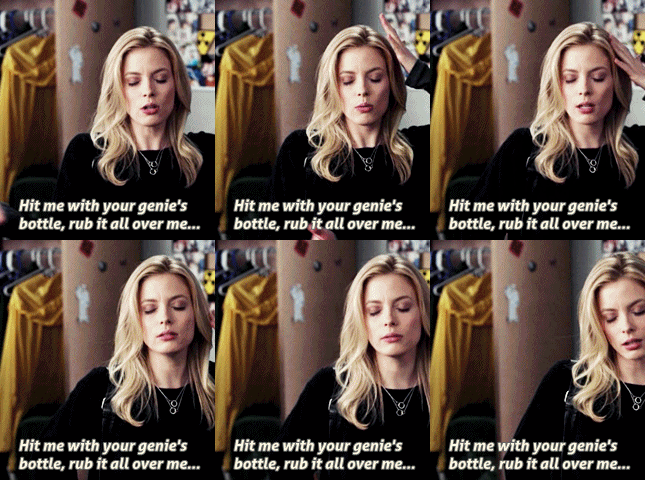
Moreover, Gillian Jacobs and Dan Harmon mention on several occasions that Britta is kind of a skank. Harmon goes on to elaborate that it’s part of her appeal: “she’s like a giant suitcase that you throw over your shoulder and go travel the world.” Britta isn’t glossy, her charm is in her grit – “Jeff needs a girl, who doesn’t wear underwear, not because Oprah told her it would spice things up. He needs a girl who doesn’t wear underwear, because she hasn’t done laundry in three weeks.” Yet we, as an audience, tend to crinkle our noses when we hear the term ‘skank’ (maybe, because it’s so close to the word ‘skunk’?). It’s an adjective used to describe a woman of loose morals. However, Britta integrates this quality in a quotidian way – we see it as a natural part of her, not a deviation from the norm, which is how male writers often frame such characters. Moreover, Britta is depicted as a modern woman with a healthy sexual appetite, and no one judges her on that account (except Shirley, but even then it’s not a big deal). She can flash Neil for concert tickets, because she does it, while maintaining her agency; she takes peyote, because she doesn’t care if she won’t be perceived by some as ‘marriage material’. Her value of herself doesn’t rest on what constitutes as ‘proper’ in society or in the eyes of men.

“I tend to play flawed women who are trying hard”.
Gillian Jacobs
Wires with Fraying Ends

Even though Britta displays an icy exterior to the world, she’s actually warm and fuzzy on the inside. Behind that prickly wall of barbed wire hides a scared little girl, whose biggest fear is to be perceived as weak for her sensitivity. That’s why she is wary of not revealing that side of her. In Communication Studies, when Jeff tells Britta she drunk dialed him, she is instantly embarrassed and avoids him at all costs. It’s Abed who sheds light on Britta’s fear of vulnerability: “Jeff, you know Britta’s defining weakness. She cuts and runs. If you do this half-assed and fail, she may leave. Then we all lose her. That’s not gonna happen, not on my watch.”
Even though, she’s not comfortable unveiling her vulnerability to others, she doesn’t deny it when being called out. For instance in Football, Feminism and You, when Shirley comments on her not being able to open up in the bathroom, Britta doesn’t defend herself by saying something like, “I’m not into that feminine crap”. Instead, she mutters under her breath, “I’ve peed alone my entire life”. She also adds that women have always hated her and it goes back to her formative years when she “got boobs before everybody else”. Girls have been rejecting her from teenage years, so she learned to be more guarded. Or when she admits that she isn’t as cool about Annie dating Vaughn: “Fine! I cared. I’m a girly girl. I like boys, and I don’t like it when they’re mean to me, and I don’t like it when they stop kissing me and start kissing my friends, I’m not that cool.”

Britta has a hard time admitting her true feelings, because of the shame associated with being sensitive. Clearly, it doesn’t match her closed-off, leather jacket-clad persona. However, what she seems to misconstrue is that sensitivity equals weakness. Therefore, when she does reveal something, we know that it’s genuine, because of the unbridled rage and childlike innocence of it. This trait is best encapsulated in this famous quote: “Knock, knock. Who’s there? Cancer. Oh, good, come on in. I thought it was Britta!”. Therefore, ironically, it’s Britta’s senstivity, and not her stoic demeanour that is her strong suit. For some reason, it is more poignant to see a more armed person come unbound, because we recognise how universal our pain is. That is why Britta’s confession in Science of Illusion, leads Annie, Shirley, Troy and Pierce to also disclose their feelings. Her bravery of showing vulnerability has provided them a safe outlet to show theirs, too.
“Hey. Abed. Why are you and I the only sane ones–”
“Shh. Just watch. It’s beautiful.”
Jeff and Abed
*Very long paragraph coming up, so buckle up!*
However, it would be a glaring omission not to point out some of Britta’s more self-destructive habits. We see her cheat on a test, because of her lack of self-confidence (Advanced Criminal Law). We discover that her sense of self-worth rests on a shaky foundation of her friends’ opinions (Bondage and Beta Male Sexuality). When Jeff cuts her off from singing Roxanne (Remedial Chaos Theory), she goes to the bathroom to smoke pot. But I think her most self-sabotaging pattern is revealed through the men that she dates – one in particular. In Abed’s succinct terms, “Britta is attracted to men in pain. It helps her pretend to be mentally healthy.” Throughout the first two seasons, the show lightly alludes to the fact that Britta likes brutal guys that endured suffering. But in the Origins of Vampire Mythology, Britta’s self-hatred reveals to us in its full bloom. We see her longing for a man named Blade, a man, who allegedly broke her heart, and because of whom she doesn’t believe in love anymore. We, as an audience, know little about Blade. All that is presented to us is that he works at a carnival. Thus, making it more of a mystery to uncover, which Jeff does. Best expressed in Annie’s exasperating question, “Who hurt you, and why didn’t it stick?” – a crucial question, which unveils the crux of Britta’s convoluted behaviour. There is a two-fold answer. One: Through Jeff we find out that Blade is clinically incapable of feeling shame, because of an old injury in the head. It could be argued that the reason why Britta feels so drawn to him is due to the inherent surplus of this emotion in her life. Therefore, just by being near him, she can vicariously imagine what that must feel like not carrying that burden with you. Two: the reason why she is attracted to emotionally unavailable men, because deep down she truly believes that’s the only thing she deserves. Coming back to Annie’s rhetorical, yet crucial question – we don’t know who hurt Britta. We can only guess. But, it resulted in her internalising this emotion of shame and worthlessness, which are inextricably linked, as the latter is the by-product of the former. I will try to elaborate on Annie’s question and provide an answer: Why yearn for a person, who isn’t interested in giving you what you want? Why get hurt over and over again? Don’t you see how twisted that is? No. The person who is trapped in a seething maelstrom of self-hatred (i.e. feeling worthless), cannot objectively analyse their behaviour without proper treatment. Again, this hatred is internalised. It’s a mechanism that functions like a broken record: mistaking familiarity (i.e. emotional unavailability) for affection.
Phew. I hope I didn’t confuse you and tire you out. But this portion was important to unveil a pattern, because it yields some unexpected results, which I will discuss in the two final sections.

When I say ‘thera’, you say ‘pist’

It is a paradox that people with deep-seated insecurities have a powerful ability to raise others. From personal experience, Britta knows what that deep pit of self-hatred is like. This makes her immune to being judgmental of others who experience it. Moreover, it makes her twice as motivated to help people. However, occasionally in her ardent pursuit to help them, she gets in her own way. Instead of doing good, she inadvertently causes good. “Functioning mad and sadly”, as the song goes.
For instance in Abed’s Uncontrollable Christmas, she worries that Abed is having a psychotic episode, so she tries to coax him into group therapy. Her motive was keeping Abed from being suspended from Greendale. Yes, it was deceitful and Abed had the right to exile her from the Cave of Frozen Memories, but if it wasn’t for her would that magical adventure onto Planet Abed even happen? And would he eventually find the meaning of Christmas? Yes, her methods were questionable, but her intentions were pure.

Similarly, in Geothermal Escapism this meddlesome side is taken up a notch – Britta attempts to forcefully make everyone admit how much they’ll miss Troy, instead of just letting them enjoy a final escapade (“I will force you to grieve properly, even if it kills us all!”). She decides to chase after Troy and Abed to make them reconcile their feelings for each other over Troy’s departure. But even here her motive was primarily fueled by the desire to help them face the inevitable pain. However, what Britta often fails to grasp, is that everyone grieves differently – not everyone can tackle their emotions head on. Yet it doesn’t render her effort any less worthy. In the same episode, Britta and Hickey (which, if I may add, made a formidable duo) team up to defeat Troy and Abed. However, when Troy says that lava is real for Abed and he almost ‘fake dies’ because of Hickey, she sees the error of her ways. Appalled by Hickey’s behaviour, Britta pushes him to the floor and comes up with the idea of ‘re-cloning’ Abed. Even here we see her desperately trying to make amends – although Britta’s thinking strays far from imaginative, she still makes an effort to conjure up an idea that can revive her friend. And incidentally, it is the clone of Abed that can reconcile with his feelings about Troy’s parting (“I don’t think lava’s here, because you’re leaving. I think it’s here because I won’t let go”). Even though he deems himself less emotional after being re-cloned, I think he’s actually become more emotionally mature. Moreover, shortly after facing true feelings about not being in each other’s lives anymore, Troy and Abed found a way to make their parting more bearable – by making versions of themselves that are more emotionally resilient. All thanks to Britta Perry.
We see that in both cases her main goal was just to alleviate pain from her friends by facing problems head-on, because she’s a realist. Britta may be good at failing, but she’s even better at making amends.
The Dark Cloud of the Group
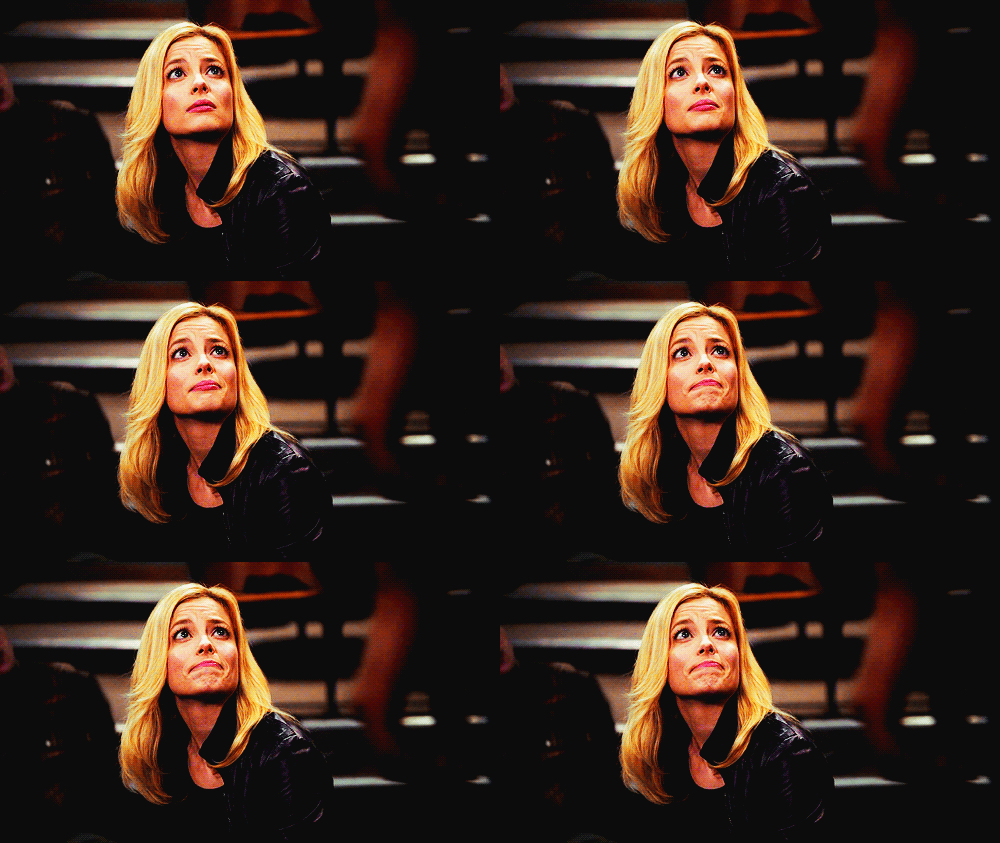
“I don’t really have a handle on this mushy stuff, if I did…we wouldn’t need you.”
Jeff Winger
What a lot of people fail to recognise, is that Britta doesn’t give advice or meddle, because she has nothing better to do. She gets involved simply because she cares. For instance, when she finds Abed his new favourite series – Inspector Spacetime. Or pays for his first film class, which would lead him moving to L.A. to work in the film industry. Or reminds Shirley about her business idea – opening Shirley’s Sandwiches, something she dreamed of doing since she started going to Greendale. Or when she accompanies Jeff, while he reconnects with his dad on Thanksgiving. Finally, if it wasn’t for Britta, who knows how Shirley’s baby would have been delivered. She put aside her fears and did what was necessary: delivered her friend’s baby. Major or minor, these changes affect characters in significant ways. And for someone sorely lacking a sense of self-worth, she is incredible at reminding people of theirs: when Annie is obsessing over Troy, she tells her point-blank, “He is failing YOUR standards, you got that?”. She also encourages them to explore outside the confines of their comfort zones. For instance in Interpretive Dance, when Troy drops modern dance, because he was afraid of the group’s reaction, she tells him that “a real man doesn’t bail on his friends or on himself”. Unwittingly, Britta becomes a catalyst to positive change for all of her friends.
“Britta, there is something in you that wants to take care of people so bad, that you’ll do it until you puke.”
Jeff Winger
What seems to unite the group around Britta is her pathos. As Pierce exclaims, “Her pain unifies us!”. Sadly for Britta, that is true. Nevertheless, she does become that centre, which people naturally gravitate towards when things become too real. She is also the group’s source of compassion – she sees good in people, even when it’s deeply buried. For instance in Spanish 101, when everyone is bagging on Pierce, she defends him by saying, “You know what he did that’s really crazy? He offered me a 100 dollars to switch cards with him just so he could be partners with Jeff. I think he thought getting closer to Jeff would bring him respect in the group. I think he looked out for himself for most of his life, and now he would trade anything for a shot at some kind of family.” I think it is moments like these that everyone is humbled by her presence.
I really hope that she learns to follow her own advice (maybe we will see it in the movie?). She is bright, intelligent and kind. And if she sets her mind on something, there is nothing in the world that will stop her stubborn, curly-haired head from achieving it. I am aware of inconsistencies regarding her character (don’t think for a second that I’m not enraged about that). But, in my opinion, she never lost her essence. Even though her own path is often inconsistent, what is constant is her being there for her friends.

In Praise of Britta Perry
Maybe Britta hasn’t got it all figured out yet. We see her in a transient period, which is familiar to many of us (myself included), when a not-so young person is still trying to find their place in the world. But, in my opinion, by the end of season six she has accomplished things that are no less significant than having a career: she faced her issues of self-hatred, and as a result dated someone who deeply cares for her; she reconnects with her parents after a long separation; and finally, she found six people who she loves and who love her in return. She realised how much braver and resilient she was than she gave herself credit for. Even if she stays a bartender forever, but remains on a self-discovery path, it is already more than enough.
Britta captures the inconsistency of human nature – grit, vulnerability, self-hatred, compassion all shaken together in a Molotov-style cocktail. She is a conduit for raw, unfiltered (yes, I went there) emotion. She is fierce, outspoken and willful, yet also gentle, kind and compassionate. When Britta embraces, she does it with such warmth and trepidation that your heart just melts. In Anthropology 101, the show ironically calls her a ‘people’s champion’, but looking back I’d say that’s exactly who she is. She reminds us that it’s okay not to always excel and be lost in life; it’s okay to have conflicting convictions; it’s okay not to always make sense to everyone else, as long as you’re being true to yourself.
Britta holds a special place in my heart. She showed me how to accept my deeply flawed self by constantly exposing herself to the world. Britta’s story is about removing her armour, piece by piece, and feeling more accepted by herself and in turn, by others. She showed me that just because people disagree with you or even don’t like you sometimes, doesn’t mean that they love you any less.
Bravo, chapeau! and a genuine thank you to Gillian Jacobs for a brilliant portrayal, and Dan Harmon for such a well-written, complex, infinitely enjoyably to watch and to emulate in real life, character.

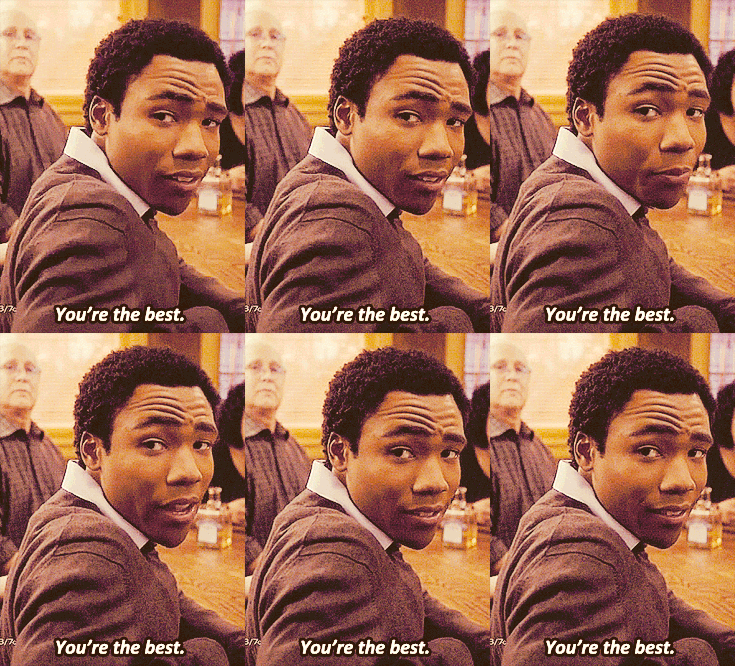
Yoip! Thank you so much for reading. Hope you made it to the end 🙂 I poured my heart and soul into this piece, because Britta got (is getting) me through some tough times. I sincerely love this woman and I wholeheartedly concur with Troy – Britta Perry is the best.
Also, I would like to thank my sister Mariya for taking the time and rigorously editing my piece, and to the talented Brittaddrawings (check out her art on Instagram!) for artistic contribution and being a fellow Britta fan.
Art credits – Alma Libera
#sixseasonandamovie
 Alma libera
I enjoyed your analysis. I like Britta as a character and enjoyed her in the show. My biggest complaint was after season 1 how Dan Harmon always used Britta to expose important moments of emotional growth in the relationship between Jeff and Annie. I would have preferred if he left her out of their story and given her more of her own arc outside of them.
LikeLike
Hi! Wow, I haven’t even noticed that Britta’s character was used in that way! Thank you for letting me know, it will be interesting to re-watch the series bearing that in mind 🙂 I agree that Britta’s role in the group’s dynamic shifts after season one. She becomes more of a source for comedy relief, which begins from Science of Illusion. Dan said that it was intentional, because they didn’t want her to be ‘the practical and sensible’ one, because no one would sympathise with her, which I don’t necessarily agree with, but the character overall remained intact imo, because of her arcs. It’s just that they decided to shift the focus from her strengths to her flaws, but it only made me love the character even more. And she still has tonnes of great qualities, it’s just that group rarely pays attention to it, hence it translates to how the audience reacts to her, too.
LikeLiked by 1 person
All very true. I think Britta has some really funny and great moments in the first 4 seasons of the show. I enjoy how she changes and really like what she brings to the group most of the time. I wish they would have given her a better defined finale arc. Seeing her go off to pursue her dream what ever it was (psychology, opening a pet rescue for disabled cats, anything) would have been better than her being a bar tender and kind of just leaving it so open ended. I am not a huge fan of season 5 and 6 and think Dan really missed an opportunity in season 6 with all the characters. I would have loved to have seen a season 6 that focused on the relationships between the various study group memeber…for example:
– a good Britta Abed story where we get to see what their friendship is like after 6 years…and maybe how each dealt with the loss of Troy. I think it would have been nice if they would have shown Britta and Abed helping each other with dealing with the absense of Troy.
– A good Britta and Annie story. They imply that they are “friends” but there is so much left unexplored between these two which could have been good.
– And then the same with all the other pairings. A really good Jeff Abed story would have been cool and could have contrasted with some of their great episodes in season 1. They have scenes in moements in s6 but not as much as I think they should have.
– And I wanted much more Jeff and Annie in season 6. Most of my favorite episodes involves them and season 6 there are (like Abed and Jeff) some good scenes but no great episodes that focus on them.
LikeLike
Oh I definitely agree about the final arc, it’s like they totally neglected her, except for the part with her parents. About her being a bartender, yeah, considering how intelligent she is, she definitely could do more with her life, but maybe it’s just a temporary period..? I hope?)) But yeah, I see her in a NGO, like the Red Cross. I reaaaally hope we see that in the movie! Oh definitely! More Britta and Abed screen time, please! I always found their pairing very poignant, and it deserved more attention! Because their emotional ranges are polar opposites, yet they shared something, which I could never put into words, but I think it is seen in their interaction in the first D&D episode. Not romantic or anything, just very human. I don’t know how to articulate it better than that)
Yes! that is actually something that can really bond them, since they were closest to that character. I agree on Annie and Britta having more episodes together. The episodes that we are given between the two are very memorable and I loved their arguments) There is also an implication that they go to malls together, but also, I just don’t picture Britta going to malls voluntarily 😀
LikeLiked by 1 person
Hi, I come across this essay on Twitter, and please accept my gratitude for it. You literally put everything, simply everything, I thought for Britta, in your essay, and I cannot describe how it made me happy. She is truly one of the most layered characters on TV and it is strange how it’s overlooked. You put every aspect of her characterization perfectly and how she is similar in a way to Fleabag and it is maybe a very good example of how narrative shapes how audiences look at characters.
When you do the character study you see how brilliant Britta actually is, but when you just take what you have given (for certain people) you see her as the worst or etc. due to other character’s behaviors. But what if Britta was the narrative-like Fleabag, then it would have been taken very differently by the audience imo.
Lastly, Gillian just shows how brilliant she is with her subtle emotions. Her two characters Mickey and Britta, two brilliant performances that are similar on paper. Yet, the way she is building their layers onto their cores is so different. You can even see they both treat their friends or reacting the way things act out. She is a really underrated actress, and Britta is a really underrated character. Yet, I remember her saying comfortable being the underdog. But, I hope she knows there are people acknowledging her work and her genuine personality. She & Britta are the best, people’s champions!
LikeLike
First of all, thank you so much for writing this again. I don’t know if my first comment is published and I forgot to copy it so I am writing it again just in case 🙂 (I basically Britta’d it.) Anyway, you put everything, simply everything I thought for Britta perfectly. One of the most layered yet, underrated and misunderstood characters by the general audience. And, the comparison between Phoebe Waller-Bridge’s Fleabag and her is very good and could be the answer for how she is taken by the certain people that are more suitable to take what is given to them rather than try to study or understand characters and their history within subcontext. Britta and Fleabag are quite similar in some ways yet, one is the narrative in her story while the other is a part of an ensemble. And, how she is treated by the ensemble called such as worst and etc. taken literally if she is worst yet, she isn’t by the many things that you said. But, while Fleabag is the narrative her interpretation by the audience is wholly different. (It could also be said that she finds her own audience with this whereas Britta’s audience more mixed.) Yet, this is actually a strength of Britta again, she maybe getting treated by the audience because of it, but, it adds another layer to her again. To continue again, to help although getting mocked by your beliefs or your failures to sit at that table along with the group every single day… She maybe did not become many things she could be, but she learned not to hate herself to make peace with herself to accept… She is truly an inspiration, people’s champion.
Gillian is another whole paragraph for me, so I will slow down myself 🙂 Both she and Britta are so underrated yet, she does not mind being one as far as I know. My only wish that, I hope she knows there are people who are appreciating her great performances with Mickey and Britta who are really good, filled with subtle many emotions along with her genuine, intelligent personality and self. She became a such good role-model for me and Britta is one of my favourite characters for sure. Hope they both get recognized more because not just because they deserve it because many people like Britta need it… to be comfortable with themselves.
LikeLike
Hi!!! First of all, thank you SO MUCH for commenting here, I know from my own experience that I rarely if never comment anything on a blog, so massive thank you for this 🙂 yes, I received both of your comments, but apparently they were pending, but I approved them now, so you may see them below. I started this article, as I said, purely out of love for this character, but also because I couldn’t believe that I was the only one who really sympathised with her! I agree with you, if Britta had her own POV like Fleabag, we as an audience would be encouraged to feel A LOT more sympathy for her. I also think that Fleabag, with all of her unattractive qualities, isn’t dismissed by guys as she would in the real life. The only character who critiques her is Martin, who is the obvious antagonist of the show. Whereas Britta gets pounded (pun unintended) a lot by guys, despite that she’s attractive and ends up dating two of them. This is a truer to life story – and on one hand, I feel like she doesn’t deserve a lot of it, but for different reasons, not because she’s attractive; but on the other hand, it shows how real life is – looks aren’t everything. There will be push-back from things you say or how you act and that’s part of life. But, as Jacobs said, she loved that that character was “undaunted by other people’s scorn”. Like that’s a really valuable lesson I think for everyone. I agree, Gillian is so incredible. After watching Community, I watched LOVE, and I loved Mickey’s character too. I can’t imagine anyone else playing either Britta or Mickey. It’s like Joel said that when Gillian first walked into the table read where she got the role for Britta, he thought, “That’s her.” There is such nuance to her performance without her being too outwardly physically expressive if that makes sense.)) And it’s just a pleasure to watch Gillian give interviews – she’s down-to-earth, yet doesn’t brag about it. Thank you again so much for the detailed response, it means SO much to me, I can’t even put it into words 🙂
LikeLiked by 1 person
My mind is literally blown by how similar we think, lol. Thank you so much again for writing this essay again. It means so much to me as well. Btw, there looks to be a growing understanding for the character as well recently (she was streets ahead during the show aired that’s for sure), as I know, from the Reddit subreddit of Community. (Plus, I happened to share your wonderful essay as well.) So, keep in mind that there are people out there who appreciate Britta & Gillian like us 🙂 I am out of words as well, much luck in the future, take care 🙂
LikeLike
Thank you ! That’s so kind of you, thanks for sharing 🙂 especially, cos I ‘m not on Twitter or Reddit, so there was no way for me to share this piece on other platforms 🙂
I am glad! Yeah, she was streets ahead, as well as the show. And I’m honestly glad there are Britta fans who are guys, because guys usually prefer Annie out of the two. I don’t think they should be compared, cos both of them are great characters and super-talented actresses, but I Britta is more unique out of the two, at least for me.
LikeLiked by 1 person
I think the Russian phrase you used, “despite the best intentions, things turned out for the worst” is especially poignant when you look at it as the literal definition of “Britta-ing” something. Like you say, Britta’s only ever trying to help, but it’s only when things that go wrong that she gets called out.
I’ll admit, I never thought to look at Britta this deeply, and it’s easy to join in with the “Britta’s the worst crowd” but there were literally moments of this article that moved me to tears. I’m excited to pay a little more attention to Britta’s character in a future rewatch.
LikeLiked by 1 person
Hi!! I am so so touched by your message. I’m glad I could convey the there is more to the character than meets the eye. I understand that it’s easy to dismiss a person who fails often. I think I was able to sympathise with her, because I am the same way and understand that she’s not failing on purpose.
Yes, I agree that that phrase describes well Britta’s modus vivendi, as well as ‘Britta’ing’)) As you can imagine, I’m not a fan of her name being used in that way though)) The phrases’ literal translation is “You wanted to do the best, but it turned out as per usual,” which I don’t think conveys the message properly in English, since “as per usual” in Russian colloquial language signifies “the worst”, that’s why I changed the wording of it.
If you don’t mind telling me, which parts did you find particularly poignant?
LikeLiked by 1 person
Specifically what touched me were the examples and explanations you gave for Britta being a catalyst to positive change for her friends; the idea that Britta continually and selflessly supported these people and helped them do and become better despite their constant mockery of her. The entire paragraph under “The Dark Cloud of the Group” just really, really spoke to me.
You also opened my eyes to the fact that so much of who Abed became over the seasons can be attributed to Britta, which really meant something to me as a person who really connected with Abed as a character. It also isn’t lost on me now that Britta is the person who invited Abed to Jeff’s “study group” in the first place, and Abed brought the rest of the group together as a result.
Overall it’s just really incredible to see someone take such a deep dive into what is my favorite show of all time, and especially so when the deep dive is not only focused on a character that I didn’t feel I related to, but helps me realize that she has a lot more to relate to than I thought. To quote a certain ex-lawyer, “I see [her] value now.”
LikeLiked by 1 person
Hi!! Sorry for getting back to you so late.
Thank you, I agree – I felt like the whole article was building up towards that section. Only after seeing Britta for who she is on the outside with all her flaws, as well as strong suits, we can truly appreciate what she does for the group. Without the build-up, it wouldn’t ring as true.
You’re right, she did invite him to the group! I forgot about that part. But yes, their whole dynamic and relationship is very touching. And I was kinda mad at Abed for never acknowledging how much she helped him, but you did it for him, so thanks 🙂
Thank you, I am very humbled by your words. I agree, Community is one of my favourite shows and I could not believe that it didn’t get recognition it deserved when it first aired. It was after all streets ahead 🙂
LikeLiked by 1 person
I stumbled on to this essay already too late and now it’s 2:30 in the morning, so I’m not going to comment in a substantial, meaningful way. But I had to comment to say how nice it is to have so many paragraphs describing what makes Britta great. She is unfairly hated upon.
LikeLiked by 1 person
Hey! Thank you so much!! Especially considering you were writing so early in the morning!)
I thought so too, because I couldn’t quite figure out why she was picked on waaaay more than everyone else? Except Pierce of course. When I heard Harmon’s analysis of Britta, it made more sense why they framed her character that way, but he went on to admit that Britta was one of his favourite characters. But some fans of the show just took the hate literally and that’s what annoyed me SO much. Like, Britta is a wildcard, without her the group would have been so bland in my opinion! Credits to the amazing Gillian Jacobs too, she really embodied that character.
LikeLiked by 1 person
I found this essay a month after everyone else – sorry! Just to say thanks for such a thoughtful and passionate defence of probably the most interesting character on the show, it was a pleasure to read. One thing though – “we don’t know who hurt Britta”. Actually we kind of do, it’s hinted at on the show and has been outright confirmed by Dan Harmon outside it that Britta was molested at her 11th birthday party by a man in a dinosaur costume and her parents didn’t believe her. This is also why she hated her parents so much (“I had to be there when they sucked”) by the way. She learned far too young that the world is a dangerous place and no one is going to stand up for her, so she’ll have to do it for herself.
LikeLiked by 1 person
Hi! Thank you so much for the feedback — yes, I heard about this incident after I posted, but didn’t know if it was confirmed or not. Sadly, it is horrific and traumatic for Britta, yet it does explain a lot of her behaviour, and it also does show the inner strength she possesses! In any case, thank you for letting me know.
LikeLiked by 1 person
I love this essay! For real, thank you thank you thank you! I just finished my first rewatch of Community, having watched it for the first time in my teens. I’m at the end of my final semester of university, so I found the final stretch of the show poignant as I look back on my undergrad experience. And this time, as an almost-postgrad trying to figure things out, I found myself connecting deeply to Britta and her struggles: she’s a kind and brilliant hot mess desperately trying to do her best.
I liked Britta as a teen, too, so this time around I was bracing myself for the mid-series decline I remembered. Before I got to Season 3, though, I read another insightful essay arguing that Britta doesn’t actually get flanderized to oblivion, as some fans suggest, but in fact continues to be sensitive and intelligent–just not recognized for it. That and Harmon’s take on Britta–that she was rounded out from a generic badass hottie into a complex and flawed character–helped me to focus on her more as she is (the best), rather than as the other leads (and some fans) construe her (the worst). I still cringed hard at points where the writing really did dumb her down, but I could better appreciate all the points where her virtues shine through. She’s hilarious and awesome and REAL!
Now I’m curious as to why you think her characterization is less consistent in Seasons 5 and 6. My impression is that the writing for her is generally weaker in Seasons 3 and 4, then she recovers some intelligence and maturity in Season 5 and figures some things out in Season 6. I’d love to hear what you think.
Here’s how I see her arc: she starts with her guard up, acting cool, then begins to let down her guard (Seasons 1-2). But with her guard down, her friends’ increasingly biting comments affect her more deeply–so she acts out, acting like she’s crazy and airheaded to conform (whether consciously or unconsciously) to her reputation (Seasons 3-4). Yet she still manages to be there for her friends (esp. Cooperative Escapism in Familial Relations) and scores some wins thanks to her grit (esp. Herstory of Dance, with Pierce’s help). At the Sophie B. Hawkins dance, Pierce explains to Jeff that Britta acts crazy because Jeff and co. put her down and use her name as a pejorative. (Side note: at the dance she’s so happy and it’s lovely to see!!!) Then next year in Duncan’s car (Bondage and Beta Male Sexuality), she realizes she’s been defining herself by others’ reactions to her. As Duncan of all people recognizes, Britta needs to realize that she’s a person even when she’s alone. Though she hits new lows the year after–homelessness, imo bullying from Annie–she manages to find her own voice in her relationships with her parents and Rick (Season 6). And finally, at Garrett’s wedding, she realizes that she not only is a person when she’s alone but also is set to THRIVE on her own. Once she’s a person apart from the group, she’s able to restore her own pride and just relax and have fun. And bittersweet as it is, she now knows how to find her individual self again. 🙂
If I’m right, then for Britta the group actually is toxic and codependent in the end. What are we to make of that? It’s grim, since it means the group didn’t actually achieve it’s purpose for everyone–or perhaps it outlasted its purpose for Britta (namely, opening her up to others) and started malfunctioning (by bringing her down). It’s not TV-tidy… but it is IRL-messy (to riff on Abed in Anthropology 101). As I see it, the dominant personalities in the group (Jeff, Abed, and Annie) make the most progress over the course of series, while the others either regress until a late redeeming upswing (Pierce, Britta… and Chang) or abort their progress arc and settle for a comforting stasis… until receiving a personal call to adventure (Shirley, Troy). The dominant three inadvertently siphon off the personal resources of the others to fuel their progress arcs–Jeff tapping Britta, Abed tapping Troy, Annie arguably tapping Shirley and Pierce–until the latter make their respective escapes. Okay wow, that’s really grim! But that seems true to life as how a close-knit, long-term group of friends can be, especially one whose members differ across the board in maturity, power, and (in)sanity.
Right, so clearly I’ve been itching to get these thoughts out onto the page! Now I feel inspired to write some Britta apologetics of my own sometime. Thanks again for sharing your insightful piece! I’m mystified and put off by people’s dislike of Britta then and now, so I’m happy to see such a strong and positive defense of the character. Britta for the WIN!
LikeLiked by 1 person
Thank you! I could never understand why so much could be forgiven by fans and the fictional study group alike from other characters (looking at Annie here) whereas any tiny mistake made by Britta had to be called out. She’s amazing, in my opinion. She deserved so much better treatment. Not that she ever needed anyone’s approval.
LikeLike
I know! I had a whole paragraph on how Annie’s behaviour (the broken Batman DVD, the occasional meltdowns) was totally okay and accepted compared to Britta’s, but I decided to omit it since the piece was already long enough and I decided that I’ve had enough proof that Britta was the best anyhow 😉
LikeLike
What do you think of the theory (which is confirmed) that Britta was sexually assaulted as a child? And how this seems to affect a lot of her self sabotage?
LikeLike
Yes, that was mentioned by Harmon. It would explain a lot. But I wanted to focus on her progress and how that experience does not define her; on the contrary — how her light shines far brighter, and her facets are so much more than this experience.
LikeLike