
Yet his journey the most beautiful of all
Once Upon A Time is probably one of the most enchanting series ever made (the close second and third would be Merlin and The 10th Kingdom) – a very beautiful and a naïve story (in the best way!), which almost feels like it’s imbued with magic. Even though, in my opinion, the storyline dissipates after season three, it doesn’t mean that I love it any less.
Each year, around Christmas I re-watch at least the first season (the best one, in my opinion), because it’s a story about hope. Yes, it’s simplistic, credulous and there are far too many inconsistencies regarding the actual town of Storybrooke, which could have been salvaged with a little attention to detail, but it’s my lighting torch in grim times.
However, where this show lacks, it compensates with its cast. I will always be mesmerized by Lana Parilla’s performance as Regina the Evil Queen, get giddy with joy when I see Rebecca Mader as Zelena the Wicked Witch of the West, be humbled by Jared S. Gilmore’s poignant and heartfelt performance as Henry Mills, be once again astounded by how Ginnifer Goodwin is the real-life embodiment of Snow White, catch myself grinning mischievously whenever Colin O’Donoghue’s rakishly good-looking Captiain Hook aka Killian Jones will appear on the screen, and always love Jennifer Morrison’s impeccable portrayal of Emma Swan, making her the perfect contemporary addition to the canon of female heroes.
But. There is one character that stands out for me (and which I appreciate more and more after re-watching the series), is Robert Carlyle’s eerie and deliciously dark portrayal of Mr Gold aka Rumplestiltskin aka The Dark One. One of the praises that the creators deservingly get was for weaving the stories of these characters in one loom in the ultimate Disney crossover. Some characters, even doubling as several protagonists – Carlyle playing Rumplestiltskin, Beast from Beauty and the Beast and the Dark One. Even though, the credits for this go primarily to the writers, the embodiment of all of these complicated and layered mythological figures goes to Mr Carlyle.
I can’t quite pinpoint what is it that makes his performance so unique; how it’s thoroughly grounded in reality, yet at the same time shrouded in myth. Whether it’s the profound depth of his brown bedroom eyes, the rolling “r’s” each time he pronounces Rumplestiltskin, or the eccentric arm gestures is up to debate. But they are just mere decorations in comparison to the innate qualities that Carlyle imbues these characters with.
Antihero, Not A Villain

At the 2011 Paley Fest panel, if I am not mistaken, Carlyle said that his inspiration partially came from his son, especially the arm gestures that Rumplestilstkin is famous for. But as I said, those are external qualities. The trait that deeply touches me is the volatility of this character. One of the main themes in the entire series is redemption. To quote, “evil isn’t born, it’s made” – a very powerful message, applicable to children, as well as adults. Both Regina and Mr Gold take strides to better themselves, yet stumbling and often reverting back to their old versions. Regina goes on to redeem herself by season two finale, and even though has some lapses in judgement throughout the following seasons, Mr Gold is a villain through and through with a few who matched his zeal for chaos (perhaps, only Zelena and his mother). That is fair enough on the writers’ part (not on the Rumbellers’ part though), because the audience loved to hate Rumplestiltskin. Besides the obvious treacherous traits of this character, Rumplestiltskin’s origin story as him becoming the Dark One is the most deeply-felt one in the entire show.
His story illustrates the frailty of human spirit, how circumstances and male stereotypes make people outcasts in their communities. Sadly, these prejudices are still rampant even in contemporary society. Throughout the first two seasons, we watch the devastating story unfold of a man being punished for his decision to be a father, rather than a hero. We see a man punished for his ‘cowardly’ behaviour to escape the war to be a stable parent for his son. We see how toxic and detrimental it is to punish a person for not complying with their gender expectations. Of course, Milah, Rumplestiltskin’s wife, had the right to leave her husband if she wished to do so. But she didn’t do it because Rumple fled from the Ogres War, but because, as she admits later herself in The Crocodile, she never truly loved him. But instead of blaming Rumple’s lack of courage for their failing marriage, she could have partially took the responsibility for it.
Rumple is the antihero of the story, not the villain. He is someone who lacks courage, which isn’t a crime, on the contrary – it’s human. We as a society, tend to give all the accolades to those who fight valiantly; who are bold, brave and strong. Yet, bravery doesn’t always have to be proved in the battlefield, but it could be proved at home, as well. I think it was very brave of Rumple to return home to raise his son, despite the anticipated backlash from the village he lives in. It takes double the courage to do that. I understand that this is a controversial statement, yet I think being a stable parent in a child’s life requires just as much bravery, as going to war. It requires a more subtle kind of bravery. Again, everyone’s opinions may differ, yet that is my take on the situation.
Rumple’s Heart
In Skin Deep, we see Rumple being unfair towards the proprietor of the flower shop, “Game of Thorns”, who as we later find out, is Belle’s father. This is one of the most tragic arcs from the entire first season, if not the show. In the throwback, we see Rumple falling in love with Belle, who just started working for him as a maid in exchange for Rumple saving her kingdom from the wrath of the ogres. Their romance blooms, as they get to know one another. Rumple is in awe of Belle and her bravery. Belle goes on to say how she never cared for Gaston, since it was an arranged marriage and that to her, “Love is layered. Love is a mystery to be uncovered.” He is moved by her and this sentiment, and we witness him gazing at her with admiration and adoration. But as soon as he marvels at the idea, his first impulse is that “She would never want to be with me. It will never happen.”
Side-note: I am aware of the accusations that romance between Rumplestiltskin and Belle, in the Beauty and the Beast arc, is symptomatic of Stockholm Syndrome, whereby the detainee becomes emotionally sympathetic towards their captor. Yet I will keep an innocent view of the situation, because I want to believe that the feelings between Belle and Rumplestiltskin are true.
So he offers her a deal, and sends her to town to fetch straw, knowing full well she will not return. But Belle comes back and tries to kiss him, soon after finding out that a True Love’s Kiss can break the spell. However, after discovering that he’s being stripped of his powers, Rumple viciously rejects her advances, as he firmly believes that her feelings are false, that this is a ruse by one of his nemeses (which it was, but another truth was that Belle did love him). He is so sure that he is not worthy of love and because it would mean losing something that safeguards him from never being in a position of vulnerability ever again. So he banishes her and later finds out from the Evil Queen that she has allegedly committed suicide. After Regina departs, we see him wrecking everything around him in throes of the loss of his true love.

Meanwhile in Storybrooke, after we find out that Rumple has regained his memories after hearing Emma Swan’s name for the first time (it was a failsafe built by Rumplestiltskin before the spell was cast), we see him react with an equal vitriol attacking Belle’s father for being responsible, as he believes, for her death. That final sequence is so heart-wrenching, I well up almost every time I see it: his pain and self-hatred are so deeply entrenched that there is no other outlet, but cause pain all around. We see him viciously smashing items in his castle, vis-á-vis Mr Gold equally harshly beating up her father, even though he is under the spell, so he doesn’t understand what precisely he is being punished for. Yet, the most convoluted thing is that Rumple is hitting himself – it’s just directed at others. Whenever I see him hitting Belle’s father, I mirror it in my head onto himself. I imagine how desolate and bitter it must be living in his skin. How much acid and bitterness he harbours, how much pain, despair and loss. It is all beautifully and tragically captured in Carlyle’s facial expressions during that scene. We see how equally he cherishes Belle’s chipped cup, which became a symbol of his ruptured heart. Not only does he cherish it, he treasures it. The love he feels for Belle is undeniable – it is pure and true. But like in real life, our past can have such a firm grip on our psyches that we don’t even know it. All we know is our fight or flight mode is activated and we are in the throes of reliving our past memories. Perhaps, Milah is set before Rumple’s eyes when Belle kisses him, and those enamourous feelings only remind him of the bitter betrayal that he experienced. For Belle, love is layered and a treasure to be uncovered. For Rumple, on the other hand, love is a mask that hides the ugly, deformed truth. He lost faith in it. He does everything in his power to eschew it from his life, to never experience it ever again, to the point as to become less attractive. Perhaps, that is the reason why his skin is covered with reptile-like swamp-coloured scales (even though we later find out that every Dark One except Emma and Hook were covered with this texture). Yet, if we imagine that there was a deeper reason for such transformation, it would be to get away from anything remotely resembling beauty, which can invoke the feeling of love. After all, as Stendhal put it, “Beauty is a promise of happiness.” What scares every fibre of Rumple’s being, is that Belle somehow manages to see past his dreary facade. She falls in love with him while he’s the Dark One, not the human being Rumplestiltskin. As Rumple says in the penultimate sequence of the season three finale and delivered so beautifully and poignantly that I cannot even express it, but I burst in tears every time I hear him say these words,
“Belle. When we met, I wasn’t just unloved and unloving. I was an enemy of love. Love had only brought me pain. My walls were up. But you broke them down. You brought me home. You brought light into my life and chased away all the darkness. And I vow to you I will never forget the distance between what I was and what I am. I owe more to you that I can ever say. How you can see the man behind the monster I will never know.”
Rumplestiltskin

This breaks my heart over and over again, because of the following. I used to think that I was someone’s Belle – that I would meet that person, and I would reel him out of that darkness, I will be his saviour (needless to say, I am a romantic to my core). Yet, a few years later, after being in a relationship and subsequently breaking up – I realised that it wasn’t the other person that needed my inner Belle. It was me. I am both Rumplestiltskin and Belle. I have that vicious monster and a trickster, the master saboteur that enjoys wreaking havoc when I am making strides forward in whichever field of my life. And I realised that I don’t need to annihilate or destroy him. I need to learn to love him, just like Belle did. I need to give an outlet to this dark part of mine, which will be organic to my being. I am my own saviour, yet I am my own dark one, too.
Even though, Belle and Rumple’s union is flawed, as he continues to deceive and break her trust over and over again, that moment in time, those exchanging of vows was so genuine and true, you believe Belle when she says that she loves him for who he is, because “sometimes the best book has the dustiest jacket. And sometimes the best teacup is chipped.” That is love in its most poignant and true form. It is based on loving someone with all their flaws. It is loving the person’s journey, not how perfect they are or seem to be. It is that reaching towards each other across the chasm and seeing the beauty of that person and their journey among the rampage and destruction of their past.
“I believe if there’s any kind of God it wouldn’t be in any of us, not you or me, but just this little space in between. If there’s any kind of magic in this world it must be in the attempt of understanding someone sharing something.”
Celine, Before Sunrise
Rumple has been closed off for such a long, long, long time (I think his story dates back the most, except for Merlin), and he was dark for most of it, that his interior is like an abandoned chamber in a dungeon: it’s pitch black and covered in dust and webs. He chained his heart and made it captive and he won’t let anyone in, because he learned early on that happiness is fleeting, and the only stable thing is power. The less emotions he feels, the more power he has. Of course, it’s a mind trick, it’s an illusion of power. Time and time again the show, albeit naïvely, yet fairly suggested that it is love for others that salvages you and renders you powerful. And the longer you keep your heart locked up, the more it makes sense to keep it that way. It does have some benefits: you don’t get hurt. Ever. And sometimes, for people who experienced more hurt in their lives than love, this is an easy choice to make. They know that others speak of this ‘happiness’ as worth any suffering, yet they don’t believe that that can happen specifically to them. Because it hasn’t in the past. So how, they ask you, should they brush all the real experiences they endured aside and blindly believe that light and love is coming their way? I think they will think a hundred times before even considering that option.
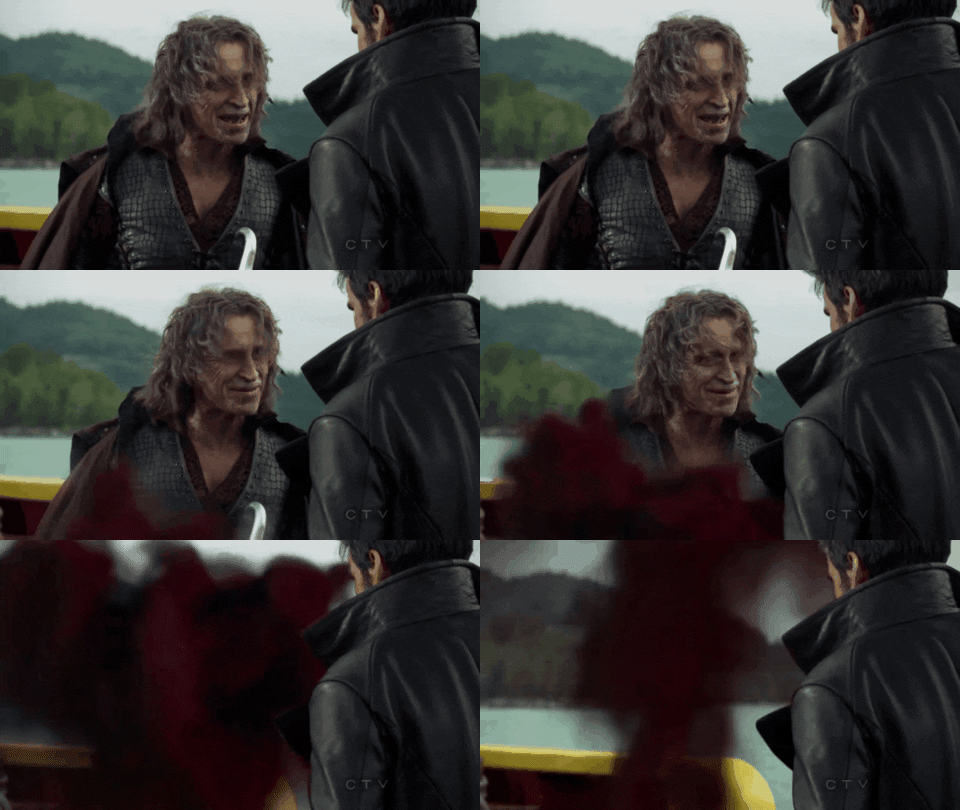
“Love makes us sick! Haunts our dreams. Love has killed more than any disease.”
Rumplestiltskin
“Love. It’s like a delicate flame. And once it’s gone, it’s gone forever.”
Mr Gold
Aren’t villains essentially that? This is not an apology for heinous crimes they commit. Yet, if we do look past it, past the scorched earth and desolation they leave in their wake, aren’t villains just people with closed-off hearts? The most stark example of this notion is Regina’s mother – Cora. That’s essentially what she did – she took her own heart and locked it away. She wanted to be so invincible, so resolute and impenetrable, that she sacrificed the most sacred thing she had – love for her daughter. She thought that this was the only way to protect herself and Regina – her legacy and extension in her eyes. But she miscalculated – the thing that her daughter wanted, and I think, maybe not all, but a lot of kids want to see their parents, is vulnerable. Because it will show they that they’re people too, hence, are also prone to making mistakes, which takes the pressure off of children. They are free to be emotional and not having to earn their parents’ love by complying with their expectations. I think that’s what Regina needed most of all – she just wanted her mum by her side. Loving her through any mistake she might have made. She might have still ended up divorcing (if such a thing existed in that time and realm or its equivalent), from Daniel, she might have still cast the Dark Curse on the Enchanted Forest, but if her mum would just be near her, providing unconditional love, Regina would know that it wasn’t her who is bad and undeserving of love; that it was just her choices that were bad. And that makes all the difference. Because, behaviour can be changed; essence of a person – cannot. And if a parent keeps telling you that ‘you’re bad’, instead of ‘I think you’re behaviour is bad’, then it plants a seed of doubt in your soul that you are inherently bad. Hence, it doesn’t matter what happens to you. If that’s the case, what’s the point in trying to become better?

I know I went on a limb here, but this is where I believe the kernel of darkness is born. That is why Emma always had the potential to be evil. Everyone does. And despite saying that I think the show dismantled after season three, I still thought that the arc with the Charmings and Maleficent and what they did to her baby was appalling, yet great in terms of writing. It truly showed that Emma is an ordinary person, who perhaps wouldn’t have been predestined to be the saviour, if not for the abominable deed her parents committed. That’s why when she finds out, it shakes her belief in herself as the light bringer (to borrow a term from George R. R. Martin), to the core. And rightfully so – how is she supposed to be confident in her powers, if her parents committed a heinous crime against another child and mother, in order to guarantee her so-called ‘saviour’ status.
A Furtive Friend
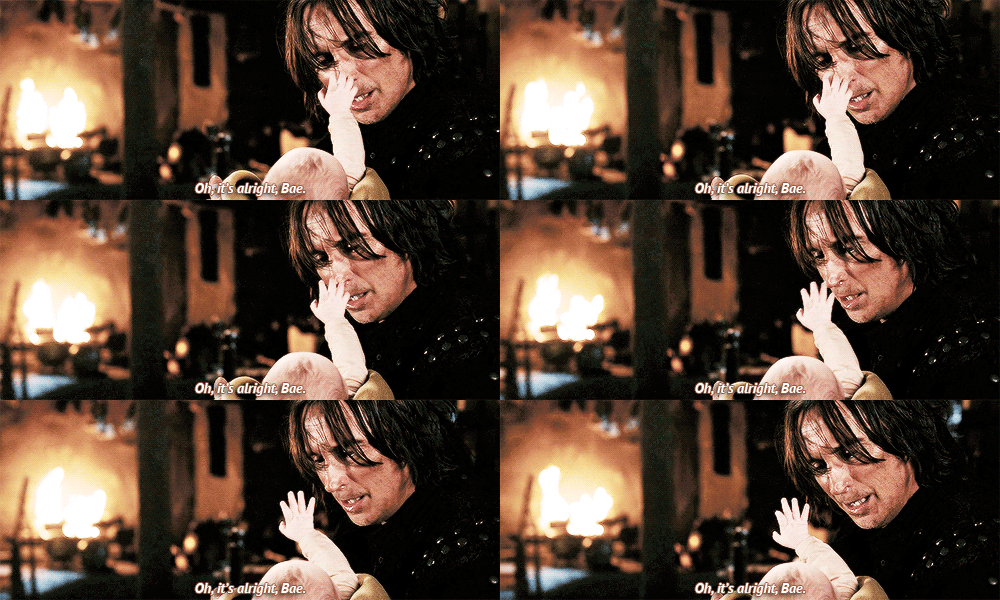
“Magic always comes with a price” – this phrase is repeated throughout the show, starting off as a sinister caution by Rumplestiltskin, and becoming a mantra of sorts. The Dark One always says that before striking a deal, as a disclaimer, as a way to be able to say “I warned you”, if or when they come complaining. Rumple knows all about that price, he paid the highest price of all – he sacrificed the only true loving connection in his life – with his son. In return, he secured his power in the form of magic. In The Return, when they are both hanging in that hollow where a portal was formed, and Bae is pleading his dad to come with him, we see Rumple’s face utterly dumbstruck – we see in that moment just how how important magic is for him, not only in his life, but in his self – we see how ingrained, how enmeshed it became with Rumple’s sense of self. Without it he doesn’t know who he is. However, shortly afterwards, and with a sense of relief, we see by his facial expression and his reaction that Rumple immediately regrets letting go of Bae (unlike his father, Peter Pan). But that moment makes something clear to the viewer: the world where Rumple is protected, is a world he prefers to the world where he is loved.
“All lives end. All hearts are broken. Caring is not an advantage, Sherlock.”
Mycroft Holmes
I remember this quote by heart. I do not agree with it, but I understand the sentiment. I know I am doing a crossover here, but it seemed fitting to the topic discussed. It mirrors Rumplestiltskin’s opinion, as well.

The symbolism of the loom – “I like to watch the wheel. Helps me forget”, Rumple admits half-absent-mindedly, to Belle in Skin Deep. To him, he’s spinning away the memories of the past, of when he abandoned Baelfire, his son, but to me, it means that he is rewinding time backwards; back to that moment in the hollow, wishing he could turn back the clock and alter his decision, to choose Bae. Essentially, that’s what he tries to do from that moment on – he tries to find his way back to Bae. From persuading Regina to take up magic and casting the Dark Curse, in order to bring him into a realm with no magic, to bringing Snow and Charming together, in order for them to create a product of True Love, which would have the power to break it…He masterminded all of this, in order to get back to Bae. So he is driven by love. Darkness didn’t win over completely.
But he still isn’t willing to part with it. Granted, he couldn’t have done all of the aforementioned without magic, yet he chooses it. And what Bae essentially wanted him to do, is to let it go, because he didn’t recognise his papa. But darkness is a furtive friend – you can’t refuse it that easily. It sneaks up on you, and before you think you have a handle on it, you realise you’ve already been compromised. You’re already in its embrace. It deftly ensnares you in its velvety arms, picks you up and carries you away. It’s seductive. It’s a promise of something new and fresh. A place, which you had no idea you could derive comfort from. That’s why this next quote, when Rumplestiltskin talks to Regina at the start of her journey as a sorceress, gave me chills:
“You think you are the diner at the feast, tasting the offerings. A little love, a little darkness. What you don’t realise is, you are the feast. And the darkness has tasted you…The darkness likes how you taste, deary. It doesn’t mind the bitterness. And now that it started the meal, it’s going to finish it.”
Rumplestiltskin

That notion that the darkness seeks out the most desperate souls is chilling. That it preys on you, but at the same time it offers you an outlet to become someone in the eyes of society you never dreamed of becoming; a chance to prove to everyone that you’re not as pitiful, frail, weak as everyone thought. It’s the flair of darkness that is alluring – the grins, the demeanour, the behaviour that is suddenly allowed are just some of the perks that it offers you. It offers you a chance to reinvent yourself, by not abiding by the rules. Rumple’s problem is that he became too good at being all of the above; it became his second skin. All the frills that I mentioned came so natural to him, because the more person is put down, the more resentment he or she harbours, the more it will yield when given the opportunity in another outlet.

“Oh. And bring that simmering rage. It’s all you have.”
Rumplestiltskin
I think we can all agree (well, at least those who watched the show), that Rumplestiltskin is one of the most enigmatic characters in OUAT. He is a villain with a capital V, and we see him wreak havoc everywhere he goes. They do make him a hero later in the seasons, but his redemption lies not there, but in his love for his son. For me, that was always his redeeming quality. On his deathbed in the midseason two finale, when he’s on the phone with Belle he utters, “You’re beautiful woman, who loved an ugly man…really, really loved me…you find goodness in others, and when it’s not there – you create it.” and then to Bae, “I spent my life looking for you…for a chance to say, I love you and I’m sorry.” And the most human moment, is when Rumple reaches his hand to Bae, saying “May I”, to which Bae replies, “I’m still angry”, and Rumple says “I know” is the confirmation that true love is present. Rumple, unlike his father, no matter how flawed he is, loved his son deeply and truly. He made a wrong choice. That choice affected ALL of Baelfire’s life. He probably will never be not mad about it. But, when all bitter sentiments are aired, what is left is…love. We are afraid how much we can forgive. And it is scary. Because love knows no bounds, and sometimes it becomes detrimental to ourselves. But such is the nature of forgiveness. It comes from the heart. And, I believe, it’s the highest form of love. And that’s what I saw in that moment. Even before Bae grabs his Papa’s hand tightly, that “I know” the heartfelt acceptance that your child might forever be mad at you, but you will never stop fighting for him regardless, is the pure form of love. And, for me I think, it’s always so poignant to see this stream of light flooding through the cave of darkness. As Leonard Cohen said in his timeless lyrics:
“There is a crack, a crack in everything,
That’s how the light gets in.”
Leonard Cohen, The Anthem
It is my honour and my pleasure to find kernels of universal truths in films, series and books, the realm of fantasy, yet which bring us closer to understanding of what life is really about.
Cover artwork is “Straw into Gold” by LicieOIC found on Deviant Art
 Alma libera