

Photo credit courtesy to the artist.
The title of the show, ‘G.R.I.T.’ – is an acronym that stands for ‘gestural, reflective and inquiring tales’, suggesting a certain physical attribute and muscle required for the artistic pursuit, or even an ‘artistic muscle’. The focus of the show centres on the process versus the resulting image and should be viewed as such. This close relationship between the hand and the mark, reveals another facet of the exhibition: inherent tactility of all displayed works. As curator of the exhibition and an artist herself, Alex Roberts, suggests, her ‘language travels between observation and material play.’
The exhibition itself is one that traverses United Kingdom and Europe, being exhibited in respective locations, Berlin and Dundee. Both locations have a strong legacy of non-traditional arts — with a focus on contemporary art in Berlin, and design in Dundee. Thus, they are perfect locations for amplifying the message of this exhibition – that the artistic process behind the completed artwork is just as important.
Roberts notes that there is a parallel between curatorship and her artistic practice — she describes it as ‘osmosis’: one feeds into the other, as both practices require ‘composing’ or ‘composition’. In the case of curating, it requires to select artists and their respective artworks, as well as to juxtapose the reception of artworks together, and in the case of painting — to compose, arrange and create compositions of poured paint, stains, coloured brush marks and so on.
Some compositions are denser than others, a cauldron of overflowing colours, textures and gestures, such as Henry Ward’s series ‘Shed Paintings’ or Angove’s ‘life-giving’ and sumptuous notebooks; while others are sparse, accentuating a spike of colour here and there, like a streaks of strobe lighting, notably Erika Krause’s ‘Untitled’.
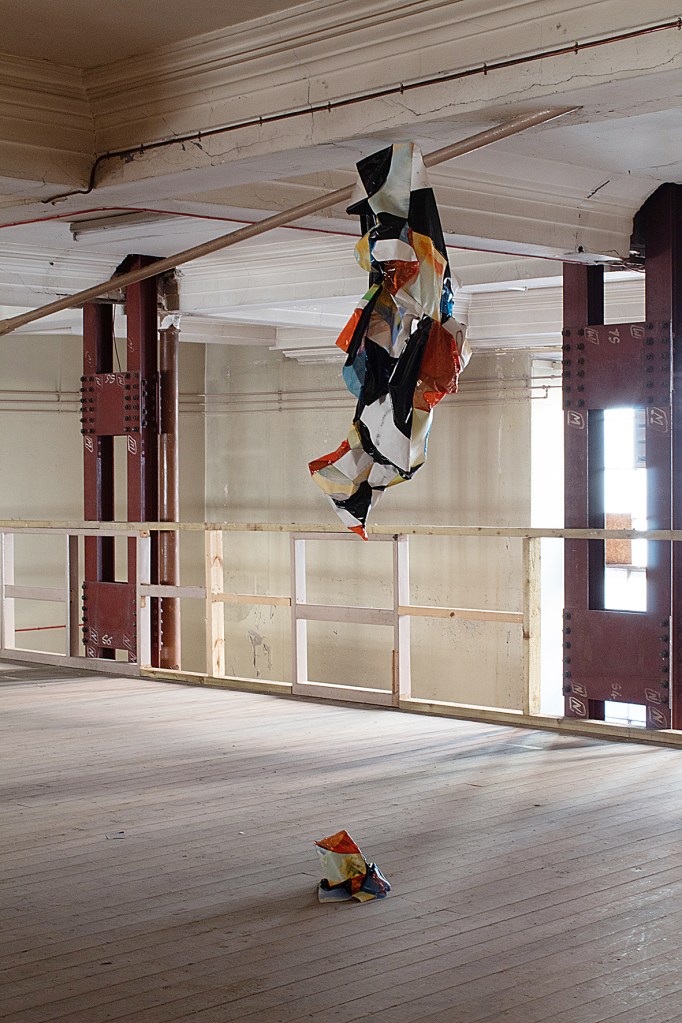
Strewn across the exhibition space (that used to be a former performance hall), each work inhabits a surface of its own, whether wooden floorboards, whitewashed walls or glass-block windows. Instead of only being hung on walls side by side, each artwork is playfully arranged within the space (with Michaela Zimmer’s ‘PARTs 240702’ quite literally hovering above the ground) and interacts with their surroundings in its own manner; neither is superior or inferior to the other. The austere interior only highlights the warmth of the pieces that collectively brim with vitality and colour, glowing throughout the industrial setting, however, stand out as separate islets. Roberts has deliberately selected natural lighting as the sole source of illumination for the exhibition, as it ‘brings forth an interesting solution to the display of artworks. This light, as it changes throughout the day, translates onto the colour palette of each artwork – during different times of day, each hue transforms, thus rendering the experience of attending the exhibition more thrilling.
For Roberts, painting is an instrument of introspection and discovery; it is not something to be simply pleasant at face value. Whilst residing in Berlin, she encountered many wonderful artists working across a variety of media, apart from painting. Roberts was surprised, and pondered, ‘where are all of the painters?’ (In hindsight, my reply to the question during the interview should have been, ‘In Florence’). This was not an entirely surprising discovery — while attending art school, painting was considered passé, not something that an artist should preoccupy themselves.
Thus, process is at the forefront of this exhibition, as Roberts is not interested in a ‘polished’, finessed look of a finalised image. Gesture – the conduit between the artist and the painting – is at the core of the show’s theme. Each of the fourteen artists incorporates gesture, in one way or another, into their work. In this exhibition, colour and gesture create a very powerful symbiosis that translates onto the page, canvas or a Lacktex oilcloth. Gesture is at the heart of artistic practice – it encapsulates the present moment; it is a visual translation of thoughts, mental images and emotional states.
When Roberts was selecting the artworks in question, she looked for the qualities that would emphasise the directness in painting and bring it centre stage. She also sought out works that could be viscerally felt and contained the ‘rawness’ and ‘immediacy’ of the painted mark that would spark off a conversation between the artwork and the viewer.
In the interview with the artist and curator, I posed a question of how process-centred artworks can, which do not offer a certain ‘polished’ look, become more appealing and engaging for the audiences. To this, Roberts replied that ‘the artworks presented at the show are ‘raw, fresh painted marks’ and offer spontaneity, which an ‘over-worked’ painting inherently does not afford. The ‘raw’ connotation also implies a certain awkwardness to the marks, however in the case of several artworks displayed, it bears a positive connotation, as it indicates a certain purity of line and gesture.
The ‘rawness’ of the displayed works, suggests the following: instead of painting an ideal image, one that where no blank space if left on a canvas imitating ‘a view from a window’ (the traditional approach taken by the academic art), the artists here rather articulate a sudden gust of emotion that can suddenly overcome a person. It can feel nonsensical, formidable and, plainly put, very messy; however, this is precisely what is being translated onto the page. The personal chaos or the state that was once considered too shameful to share with the world, is being unleashed onto the canvas, with preference for authenticity over, for instance, a symmetric composition.

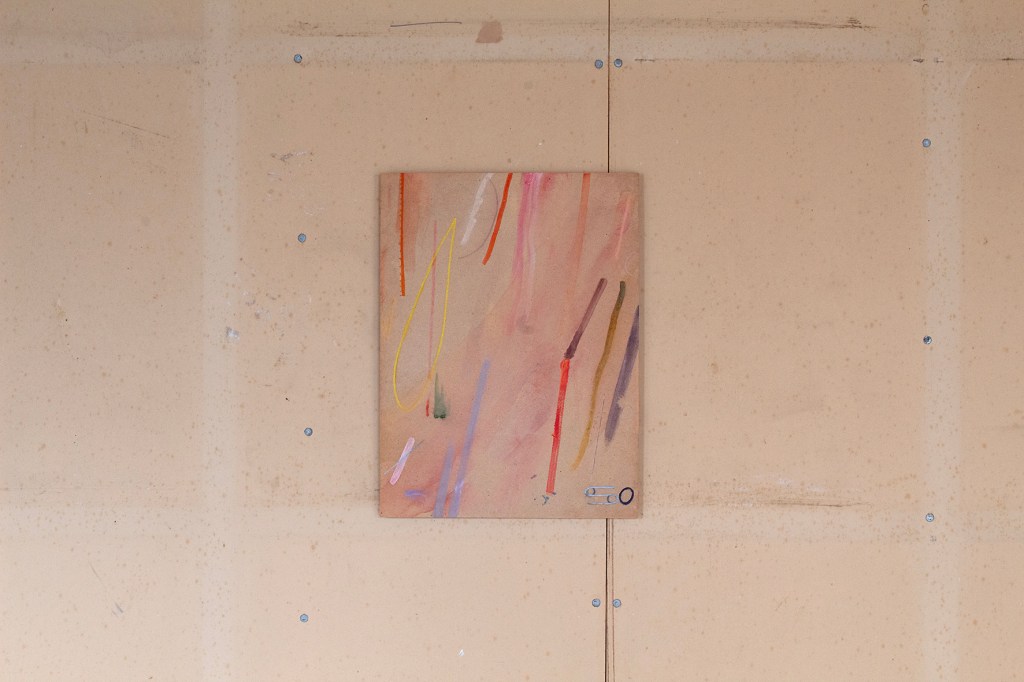
The variety of artworks on display highlights the variance in ‘heft’ and ‘viscosity’ of each artist’s ‘G.R.I.T.’ (Gestural, Reflective, Inquiring, Tales), helping to reveal their idiosyncrasy or ‘signature’. For instance, Geraldine Swayne’s Roz (see at the beginning of the article) is painted with delicate washes of colour, layered on top of each other; while Henry Ward’s Shed Paintings series displays a confident graphic language (see below). As the press release describes Ward’s oeuvre, artworks are at an intersection of ‘abstract and representation’, depicting formations and landscapes.
All artworks, whether crunched up vinyl oilcloths or paintings, have one quality in common – they are all quite visceral and sensual. Some of them are more representational, the others are more abstract; but what they all have in common is their ‘desire to stop the viewer in their tracks.’ This, according to Roberts, is what she was looking for while compiling pieces for this exhibition.

The gestural language of each artist links with the colour palette, too. Ward’s marks are strident and confident, suggesting a rapid process. Geraldine Swayne’s speed of painting translating as instant slippage of colour application. Ward’s cooler mauve hue rapidly shifts to the warmer vermillion at a fast pace in a staccato rhythm, quickly alternating from one sheet to the other, inducing in the viewer an almost feverish state between ‘hot’ and ‘cold’ colour tones. It almost appears as if one is watching a brightly animated cartoon or even a Formula One race. While Swayne’s offers more earthy tones, even reds recall raspberry jam and moss green, reflecting on the contemplativeness and overall serenity of the composition.
Colour is also be used to create iridescent and three-dimensional textures that can be observed in Angove’s sketchbooks. The masterful use of colours creates an impression of a moving colour and velvety texture that has its own dimension.

59.5 x 43 cm, G.R.I.T. Dundee, 13 September – 12 October, 2024, Drawing Projects UK, Scotland. Photo credit @painting_grit.
Across the board, the artists use paint as a graphic medium. If one considers Cy Twombly’s works, and his visual language that encapsulates both drawing and writing, it becomes clear that artists aspire to the same universality in their works. It is an exercise in intuitive mark-making and flow, rather than constructing a perfect picture. It is an exercise in continuous line, rather than hammering at the same spot of canvas or paper to achieve a realistic effect. The works in ‘G.R.I.T.’ are fun, multidimensional, and provocative – but they are not taking themselves too seriously. The varying sizes of artworks help to calibrate between the different qualities: from an intimate notebook format to painted glass panels, and MDF board to Lacktex oilcloth.
On a personal note, I am very fond of the continuous line exercise, whereby one draws a human figure, a portrait, a flower, a building, without taking their hand off the page. This emphasises a certain interconnectedness between the eye, arm, hand, the medium and the surface. Viewing art from the perspective of such a pentagonal arrangement discloses the breadth of such approach, that offers to see abstract art in a different light.
As Tim Ingold poses in his seminal book, Making, ‘Projection is optical, but telling is haptic – whether by hand or by eye. It is feeling-full.’ Thus, what abstract artists, notably Mark Rothko, aimed to achieve by focusing on the materials and colours themselves that translates emotion, rather than a projected image.
Another term that encapsulates the works in this exhibition is ‘mutability’, as described by Anita Taylor, an exhibiting artist and educator at the University of Dundee. Gesture is fluid and is subject to change at any given moment. Thus, it is a very interesting juxtaposition — bodies as subject matter and instruments themselves. Where do the bodies end and an artwork begin, or vice versa? They become powerful conduits of delivering art onto the page or surface in this context by their respective creators. Therefore, ‘G.R.I.T.’ exhibition reminding us, that all artworks centering on gesture and process must be comprehensively embraced in a real-life visit.
When I suggest whether the German artist and printmaker Kathe Köllwitz was an inspiration at all, Roberts wholeheartedly agrees – every art piece at the exhibition echoes Köllwitz’s spirit in one way or another. The raw and immediate marks are translated into truthfulness and authenticity, a value that modern artists have embraced the most. Whether to colour, painting, feeling, art is sought out in its purer form.
Exhibition Dates:
‘G.R.I.T. Gestural, Reflective and Iniquiring Tales: a painting exhibition bridging Europe’.
9-31 August 2024, KUNSTPUNKT Berlin / 13 September – 12 October 2024, Drawing Projects UK, Scotland.
 Alma libera